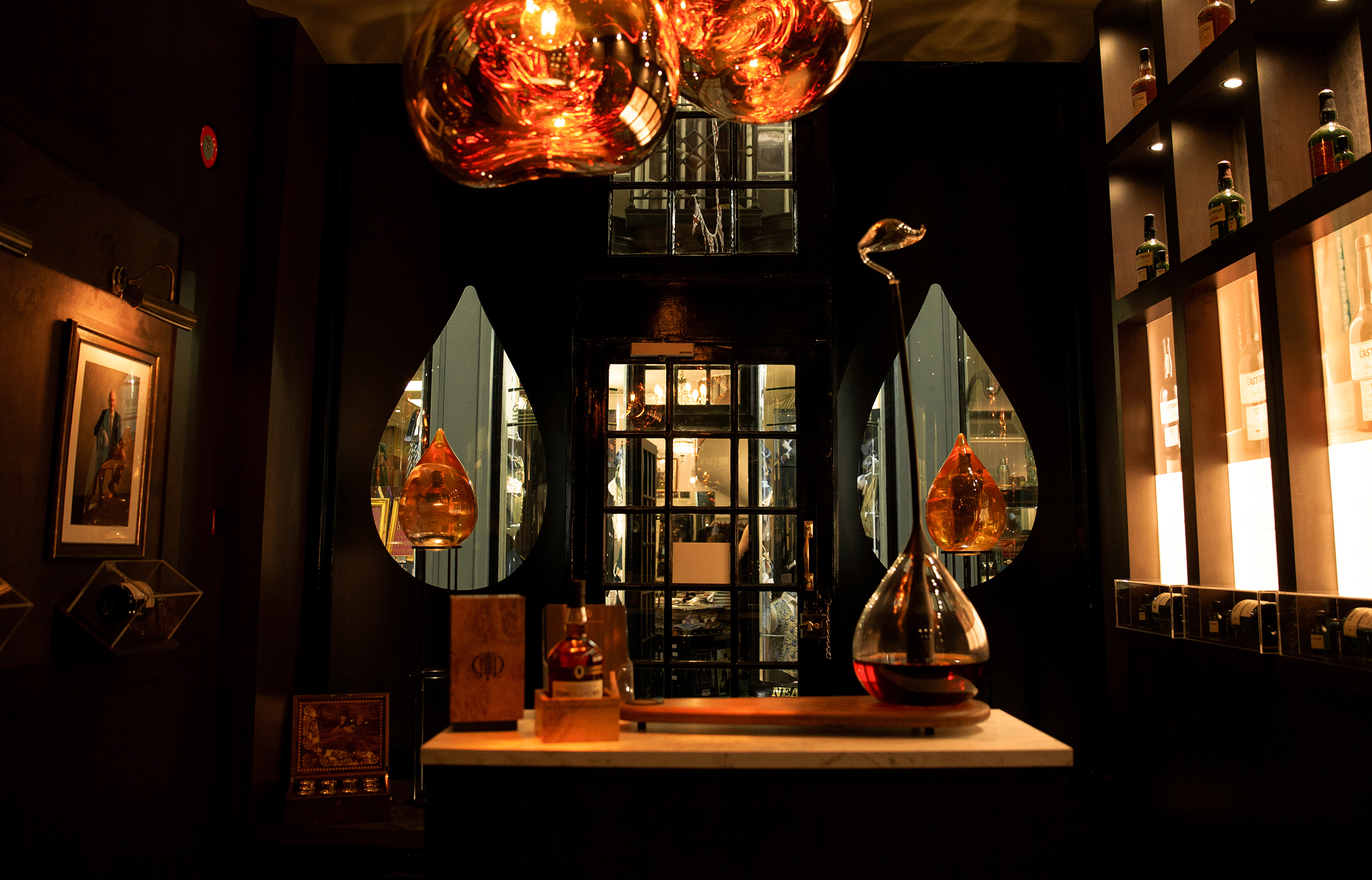
Pie Factory designed and built the first flagship store for The Last Drop Distillers, on Piccadilly in London. It is a brand home rather than a retail destination, and a working venue for tastings. The project was not carbon measured.
The Last Drop Distillers · Piccadilly · London, UK · Luxury and beauty · Design; Production; Project Management
A first flagship store on Piccadilly that would not behave like a shop. A visitor should be able to spend time with rare releases and hear the story behind each bottle without being sold to, because a purchase at this level is made over a conversation rather than off a shelf. The store also had to earn the space outside trading hours. The commercial reason is dwell and second use: a room that hosts tastings, showcases, private workshops and client events is working on more evenings than a shop floor is.
Pie Factory took the store from design through to build. The plan is organised around spatial flow rather than fixture runs. A visitor moves through in a sequence, meeting rare releases in order, with room to stop at each one. Display is built to let a bottle be looked at closely and, where appropriate, handled, and the story behind each release sits with the bottle rather than on a separate graphic wall. Materiality does the work on tone: the brief pulled towards luxury and towards warmth, so the palette pairs hard, precise surfaces with softer and more tactile ones rather than choosing one register. The same room is a stage, holding tastings, showcases, workshops and events, which means the fixtures have to clear or serve, the lighting has to switch from retail to evening, and the surfaces have to take glassware and spillage without marking.
Two uses, one room. Display wants fixed positions, a controlled sightline and a fixture that is not moved. A tasting or a workshop wants clear floor, seating, a serving surface and the ability to reset in an hour. Piccadilly adds the usual central London problems: no loading bay, restricted delivery hours, and every panel and fixture sized to come through a shopfront door.
This project was not carbon measured. No impact report exists, so there is no figure, and none should be borrowed from another project. What is on record is the scope: the brand's first flagship store, designed and built by Pie Factory, running as a brand home and as a venue. A permanent store is the one build type where the carbon case is straightforward, because a fixture that stays in place for years has no freight, no storage and no refit cycle attached to it. That was not measured here. Any future fit out for this client should have measurement scoped in at design stage.